
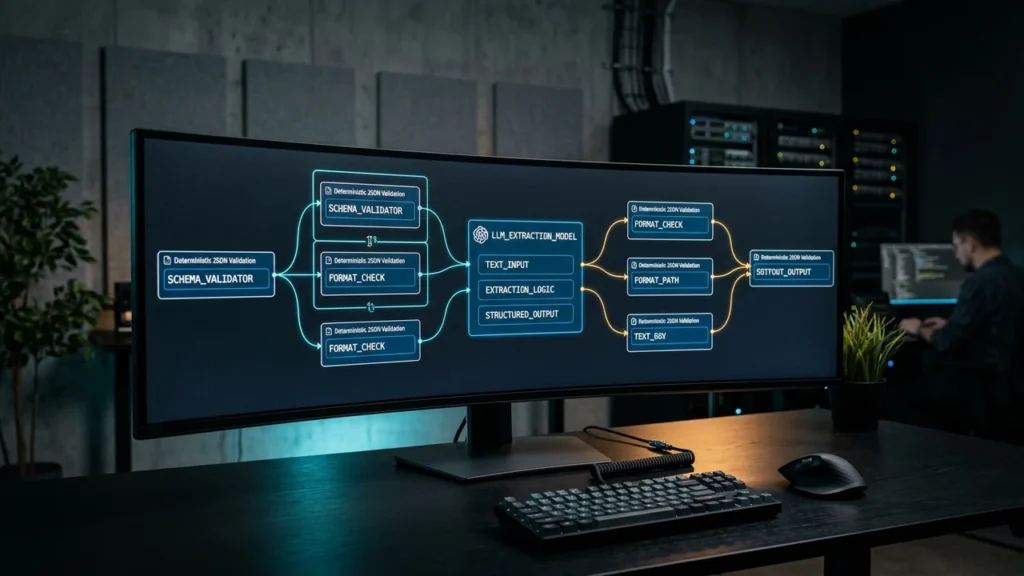
Over the past decade, digital transformation was synonymous with rule-based workflow automation. Operations teams connected their CRM, ERP, billing software, and customer support platforms using deterministic “If-This-Then-That” pipelines. Whenever a structured trigger occurred in System A, a predefined sequence of API calls updated System B. However, traditional workflow automation hits an immediate wall the moment inputs become unstructured, ambiguous, or context-dependent – such as parsing an angry customer email, extracting line items from a non-standard PDF vendor invoice, or triaging a complex technical support ticket.
Today, the integration of Large Language Models (LLMs), vision transformers, and autonomous reasoning agents into enterprise pipelines has created a major architectural fork: AI automation vs. traditional workflow automation: which approach fits the process?
Deploying generative AI where a simple deterministic script belongs wastes compute budget and introduces unnecessary hallucination risk. Conversely, forcing rigid conditional rules onto messy human language creates brittle workflows that break daily. This engineering guide from Inceptial Tech defines the exact architectural boundaries between traditional deterministic workflows, AI-augmented pipelines, and autonomous agentic systems.
1. Traditional Workflow Automation: The Power of Deterministic Precision
Traditional workflow automation (whether built via custom Python/Node.js microservices, RPA bots, or orchestration engines like Make and n8n) operates on strict boolean logic and structured schemas. If Condition X equals True, execute Function Y.
Core Architectural Characteristics
- 100% Deterministic Output: Given the exact same JSON input payload ten thousand times, a traditional workflow produces the exact same output ten thousand times with zero variance.
- Structured Data Requirement: Traditional automation requires predictable keys, strict data types (integers, ISO timestamps, standardized dropdown strings), and fixed API contracts.
- Sub-Second Execution & Ultra-Low Compute Cost: Evaluating an
if/elsebranch or mapping JSON fields consumes microseconds of CPU time and costs fractions of a cent per thousand executions. - Complete Auditability: Every execution step follows a transparent, hard-coded path that satisfies strict financial, healthcare, and regulatory compliance audits.
Processes That Belong Strictly in Traditional Automation
Never use an LLM for mathematical ledger calculations, tax computations, inventory stock decrements, user permission provisioning, or database synchronization between standardized SaaS tables. When inputs and outputs are structured and accuracy must be 100.0%, deterministic code is non-negotiable.
2. AI Automation: Probabilistic Reasoning Over Unstructured Data
AI automation introduces machine learning models and LLMs (via structured tool-calling APIs, embeddings, and Retrieval-Augmented Generation) into the execution loop. Instead of matching exact text strings with regular expressions, AI automation evaluates semantic meaning, intent, sentiment, and unstructured visual or textual context.
Core Architectural Characteristics
- Unstructured Input Ingestion: Capable of reading free-form emails, voice transcripts, scanned multi-layout PDFs, legal contracts, and customer chat logs, converting messy human communication into clean, schema-validated JSON objects.
- Contextual Classification & Synthesis: Can evaluate five different knowledge base articles alongside a customer’s order history and draft a contextually accurate response or route the issue to the exact engineering squad.
- Probabilistic Execution: Because LLMs predict token distributions, outputs are inherently probabilistic rather than deterministic, requiring guardrails, low temperature settings (
temperature: 0.0), and strict JSON Schema validation (such as Pydantic or OpenAI Structured Outputs). - Higher Latency and Token Cost: LLM inference adds 500ms to 5,000ms of latency per step and incurs per-token API costs.
3. Head-to-Head Engineering Comparison Matrix
- Input Data Format: Traditional automation requires structured JSON, CSV, or SQL rows; AI automation excels at unstructured text, PDFs, audio, images, and natural language.
- Logic Paradigm: Traditional automation uses explicit rule-based trees (If/Else, Switch, Regex); AI automation uses semantic understanding, intent classification, and multi-step reasoning.
- Failure Mode: Traditional automation fails loudly with schema errors when an unexpected field format arrives; AI automation adapts to format changes but risks subtle hallucination if unguarded.
- Maintenance Overhead: Traditional automation requires manual rule updates whenever edge cases expand; AI automation scales across new edge cases via prompt engineering, few-shot examples, and RAG context updates.
4. The Enterprise Gold Standard: Hybrid Deterministic + AI Architecture
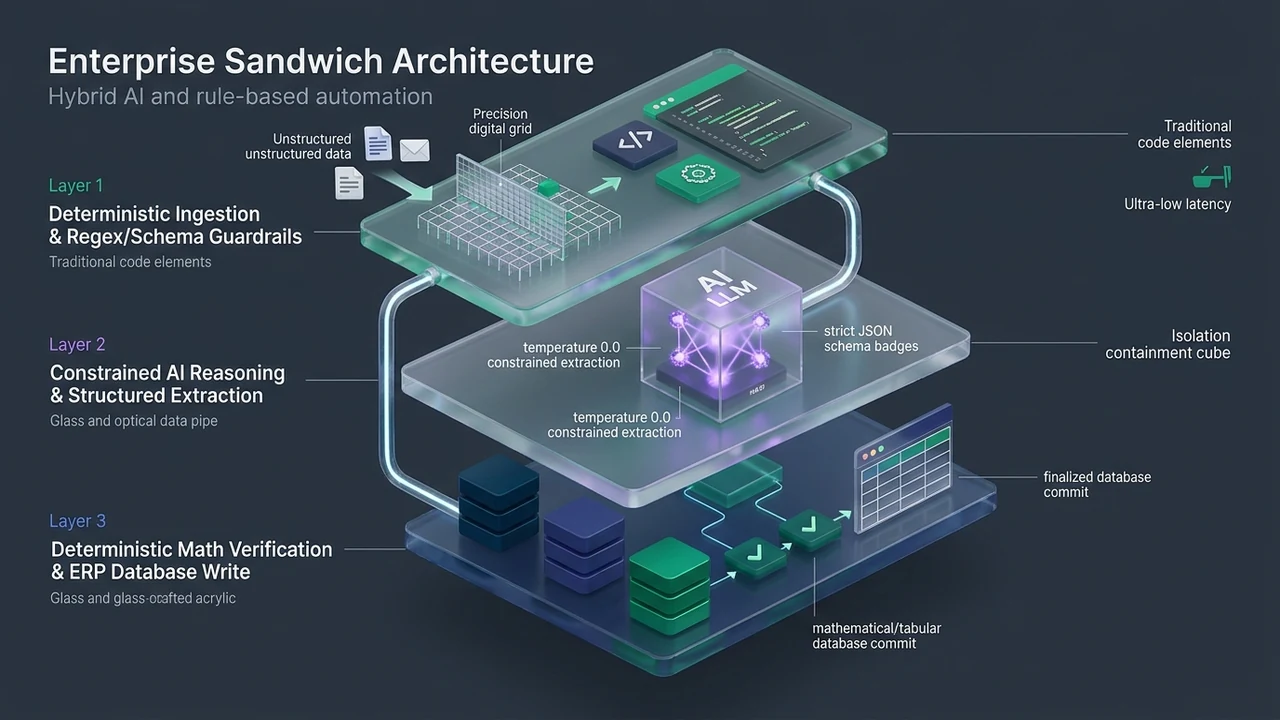
In production software engineering, the most resilient enterprise systems do not replace traditional workflow automation with AI. Instead, they embed constrained AI reasoning nodes inside a deterministic workflow wrapper – a pattern known as the Sandwich Architecture:

- Layer 1 – Deterministic Ingestion & Sanitization (Traditional): A webhook receives an incoming vendor invoice email, strips PII, validates the sender domain against the ERP database, and extracts the raw document attachment.
- Layer 2 – Structured Cognitive Extraction (AI Node): An LLM vision/extraction model parses the unstructured PDF layout and returns a strictly typed JSON object containing
invoice_number,line_items,subtotal, and aconfidence_score. - Layer 3 – Deterministic Validation & Execution (Traditional): Traditional code mathematically verifies that the sum of
line_itemsequals thesubtotal, checks thatconfidence_score >= 0.95, routes low-confidence exceptions to a human-in-the-loop Slack approval queue, and posts verified records to NetSuite via REST API.
5. Step-by-Step Decision Framework for Your Process
Ask these four architectural questions before building your next automation:
- Can the decision rule be written in 10 lines of explicit If/Else logic? If yes, use traditional workflow automation.
- Does the input arrive as free-form human language, varied documents, or images? If yes, use an AI extraction/classification node to convert the unstructured input into structured JSON first.
- What is the cost of a 1% error rate? If a 1% error causes financial misreporting or security breaches, keep the core execution deterministic and require human-in-the-loop sign-off for AI recommendations.
- Are rules breaking every week due to new input phrasing? Replace brittle regex chains with a schema-constrained LLM classifier.
Frequently Asked Questions
How do you prevent AI automations from hallucinating bad data into our CRM?
We enforce strict JSON Schema outputs (forcing the model to select only from allowed enum categories or return null), ground the model exclusively in retrieved company documents via RAG, set inference temperature to zero, and run deterministic programmatic validation checks before any database write occurs.
Is AI automation more expensive to run than traditional workflows?
While LLM API tokens cost more per execution than raw CPU cycles, routing routine tasks to lightweight, fast frontier models (or fine-tuned small models) typically costs fractions of a penny per task – saving hundreds of hours of manual human triage labor every month.